
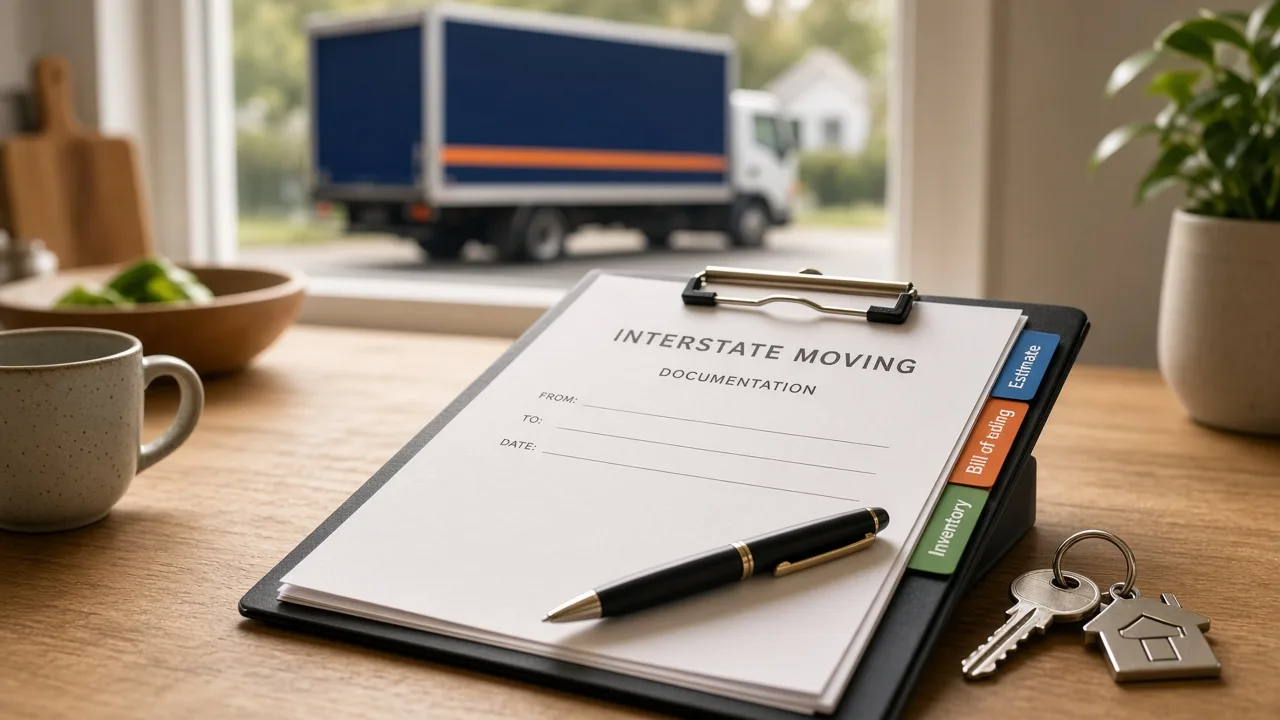

Most interstate move checklist articles online mix DMV updates, school transfers, and box counts. Those tasks matter—but they do not protect you when a delivery window slips, a shuttle fee appears, or a high-value item arrives damaged. For a household shipment that crosses a state line, the documents FMCSA requires are the control system for price, services, condition, and claims.
This guide is a paperwork-first interstate moving documents checklist for shippers starting in California (or anywhere BLVD loads an interstate shipment). It is not legal advice. Pair it with FMCSA Protect Your Move, the agency’s tips for a successful move, and the FTC’s guidance on hiring a mover, then verify every detail against what you actually sign.
If your move stays entirely inside California, BHGS rules and a Not to Exceed estimate apply instead—use the California moving estimate guide for that path. This article is only for interstate household goods.
Why interstate paperwork differs from a local California move
| Topic | Intrastate California household move | Interstate household move |
|---|---|---|
| Primary regulator | BHGS | FMCSA |
| Core price document | Written Not to Exceed estimate after visual inspection | Written estimate (binding, non-binding, or binding-not-to-exceed when offered) plus tariff-based charges |
| Contract at pickup | State forms and agreement | Bill of lading (contract and receipt) |
| Mover lookup | California household mover search | FMCSA registered mover search |
Crossing into Nevada, Oregon, Arizona, Texas, or any other state triggers the right-hand column—even when the truck leaves from Los Angeles, San Francisco, San Diego, or Sacramento. Treat interstate paperwork as a single thread: each document should match the ones before it.
BLVD plans long-distance moving across California service locations and beyond. Before you deposit, confirm the legal name and USDOT 2892909 · MC 971895 on your estimate match FMCSA’s lookup, and request BLVD’s interstate moving tariff for review so published accessorials and service terms are visible early.
Before you book: estimate and verification records
Written estimate (not a verbal total)
FMCSA consumer guidance is clear: do not accept verbal estimates and do not sign blank or incomplete estimates. Your written estimate should identify:
- Legal company name, address, and USDOT number (and broker/carrier roles if applicable).
- Origin, destination, and requested service dates or windows.
- Inventory, weight survey method, or cube assumptions tied to the price.
- Packing, crating, storage-in-transit, shuttle, stair, elevator, and long-carry services.
- Valuation (mover liability) option and any declared value.
- Estimate type—binding, non-binding, or binding-not-to-exceed when offered—and how changes are handled.
For California-origin addresses, capture access that affects line-haul pricing: hillside driveways, narrow streets that require a shuttle to a smaller truck, long carries from parking, elevator reservations, and HOA or building move windows. If those conditions are missing from the estimate, they are not part of the quoted scope.
Compare interstate quotes on identical inventory using the moving estimate comparison worksheet and the deeper walkthrough in California moving estimates explained.
Your pre-booking file
Start a move folder (cloud backup plus paper when signed):
- Screenshots or PDFs from FMCSA’s mover search for every company name on the estimate.
- The full written estimate and any tariff excerpts you requested.
- Emails confirming delivery spread dates, storage plans, or specialty handling.
- Photos of access at both addresses.
Never store the only copy of these records inside the shipment.
At booking: order for service
The order for service confirms what you asked the mover to perform. Before you authorize load day, line it up against the estimate:
- Contact names, phones, and addresses at origin and destination.
- Requested pickup and delivery dates or spread windows.
- Services, packing scope, and storage-in-transit (SIT) if applicable.
- Valuation selection and payment terms (deposits, balances, accepted methods).
- Any third-party or broker arrangement disclosed in writing.
Correct typos, missing access notes, or service gaps before the truck is loaded. An order that contradicts the estimate is a red flag—resolve it in writing, not on the driveway.
Load day: bill of lading, inventory, and rights booklet
Bill of lading (contract and receipt)
FMCSA describes the bill of lading as the contract between you and the mover and a receipt for your goods. Read every page before signing. Confirm:
- Company identity matches the estimate and FMCSA lookup.
- Origin and destination addresses and service dates match the order for service.
- Services, valuation, and charges align with documents you already approved.
- You understand delivery timing language (single date vs. spread vs. post-storage delivery).
SERP questions such as “Is a BOL legally required?” reflect real confusion: on regulated interstate household moves, the bill of lading is the operative contract—treat it that way.
Shipment inventory
The mover prepares an inventory listing shipped items and condition codes at pickup. Walk the list—do not sign on autopilot.
- Confirm major furniture, appliances, cartons, and specialty pieces appear.
- Ask what abbreviations mean before you initial each page.
- Photograph high-value or pre-existing damage.
- Keep your signed copy accessible during transit.
You will use the same inventory at delivery to check item numbers and note exceptions.
Rights and responsibilities information
Interstate movers must provide federally required consumer information (often called the Your Rights and Responsibilities When You Move booklet). Read it before loading so you understand estimates, delivery, payment limits on non-binding moves, claims, and dispute options. FMCSA’s moving checklist PDF is a useful companion—not a substitute for your signed stack.
Valuation and high-value articles
Valuation is mover liability under the contract—not the same as homeowners or renters insurance. Review options, costs, exclusions, and the process for high-value articles. Declare items as the agreement requires; keep receipts, appraisals, serial numbers, and photos where appropriate.
In transit: contacts, storage, and tariff-based charges
Record driver or dispatch contact information and the shipment reference number the day of load.
If your California departure date or destination access requires storage-in-transit, confirm warehouse location, monthly charges, and redelivery terms in writing before goods enter storage. Tariff language—not a verbal promise—controls many accessorial fees.
When a charge surprises you, compare it to the estimate, order for service, bill of lading, and tariff sections you reviewed at booking. How to avoid hidden fees when hiring movers explains common mismatch patterns; how to choose a moving company in California covers vetting before you sign.
At delivery: inventory check and payment records
At destination:
- Check item numbers against the load-out inventory before you sign a clear delivery receipt.
- Note missing or visibly damaged items using the mover’s required process—do not sign language you do not understand.
- Match payment method and amount to the contract; retain receipts.
- Photograph exceptions the same day.
If you need a broader move-day timeline (crew arrival, final walk-through), see what to expect on moving day. For packing and downsizing before the truck arrives, how to prepare for a long-distance move complements this document list.
After delivery: claims and record retention
If property is lost or damaged, follow the claims notice instructions in your paperwork and FMCSA consumer materials. Keep:
- The complete signed document stack (estimate through delivery).
- Inventory pages from both pickup and delivery.
- Photos, repair estimates, and payment records.
Timelines are contract- and rule-driven; missing a notice window can limit recovery even when damage is obvious.
One move file, stored twice
Maintain digital and paper copies of every document, photo, receipt, email, and payment record for the shipment. Label the folder with your USDOT carrier name and move date. Share read-only access with a family member who is not traveling with the goods.
Request a written interstate quote
Ready to line up paperwork before load day? Share origin and destination addresses, dates, inventory, access details, packing scope, and storage needs through BLVD’s free moving quote request. Complete information helps operations issue a written estimate tied to the shipment you actually plan to move.
Related guides
- California Moving Estimates Explained — intrastate Not to Exceed vs. interstate tariff pricing
- How Much Do Movers Cost? — line items to compare across quotes
- Interstate moving tariff — request BLVD’s tariff for review before booking